
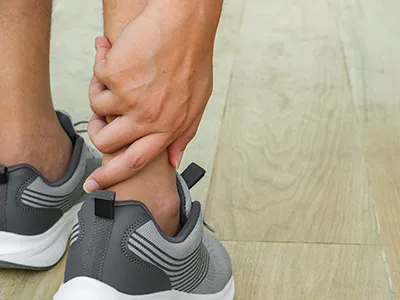
Achilles Tendinopathy makes itself known with stiffness, a dull ache or sharp pain in the back of the lower leg or heel. Common triggers range from fluoroquinolone antibiotics to overuse that exceeds the tendon's capacity to repair itself. Achilles Tendinopathy recovery is slow, and load management is the foundation. Regenerative Medicine options can be effective, including PRP or Prolotherapy, to help avoid surgery, but they should only be considered if a well-run loading program has not proven effective.
Call (240) 754-7954 or contact us online to arrange a consultation with our Orthopedic and Sports Medicine specialists at our offices in Alexandria, Virginia, or Waldorf, Maryland.
The Achilles tendon is the thickest and strongest band of fibrous tissue in the human body. It connects your calf muscles to your heel bone and allows you to walk, run and jump. You have two Achilles tendons, and they are located at the back of each lower leg, starting near the middle of your calf down to your heel. It is most visible and prominent at the back of the lower ankle.
Achilles Tendinopathy is a common overuse condition involving structural degeneration, pain, swelling and stiffness in this large tendon. It can cause loss of function and mobility. A complete loss of mobility, however, usually means you are dealing with a complete tear, known as Achilles tendon rupture.
From runners, jumpers and court or field athletes to active midlife adults ramping up mileage or returning after a layoff, Achilles Tendonopathy usually has a long healing curve. Recovery is measured in months, and loading is the foundation of any treatment plan.
For proper diagnosis and treatment of Achilles Tendinopathy, it’s important to be thoroughly evaluated by an expert Sports Medicine clinic that is experienced in non-surgical treatment and Regenerative Medicine options. In Alexandria, VA or Waldorf, MD, the Center for Sports & Regenerative Orthopedics can provide a full-service evaluation, diagnosis and personalized treatment plan for Achilles Tendinopathy.
Tendinopathy is a general term for chronic tendon pain and structural degeneration which involves the breakdown of collagen fibers. But it is a complex, non-inflammatory cellular and matrix adaptation failure characterized by more than collagen breakdown. It involves an array of issues including:
Tendonitis, on the other hand, refers specifically to acute inflammation of the tendon tissue. Achilles Tendonitis is usually a short-term issue caused by a sudden injury. It is often accompanied by local swelling, redness and heat. Most long-term tendon pain involves tissue breakdown (tendinopathy) rather than inflammation (tendonitis).
Since Achilles Tendinopathy is a loading/tissue problem, not “inflammation," common triggers and risk factors are not the same as those you would see with a case of tendonitis.
The most common cause of Achilles tendinopathy is overuse that exceeds the tendon's capacity to repair itself. Overuse scenarios might include:
Training spikes are a common culprit – doing too much too soon or beginning training on hills. Other common triggers or risk factors include:
The use of fluoroquinolone antibiotics is another lesser-known risk factor. Some people experience Achilles Tendinopathy when using medication from this family of antibiotics, like Ciprofloxacin (commonly known as Cipro). Even if you’ve taken these types of antibiotics before without experiencing any issues, you never can be sure how these drugs will impact your Achilles tendons.
They carry an official “black-box warning” for increasing the risk of tendinopathy, tendon inflammation, tears and even complete ruptures.1
Achilles Tendinopathy often presents as stiffness, especially when first awakening in the morning or after sitting for long time. It may also make itself known with a dull ache or sharp pain in the back of the lower leg or heel.
Other signs and symptoms include:
Pain: Slow-onset aching pain. Pain typically increases slowly over weeks to months from repetitive loading, with no single dramatic moment of injury. Pain often feels sharp at the onset of activity then eases off as the tissue warms up with movement or exercise. It then throbs heavily hours later or the next morning.
Popping: A clicking, popping or a crackling sound or sensation (called crepitus) can happen. It occurs when changes in the tendon or its surrounding sheath make movement less smooth. If there is instead a single, loud "pop," accompanied by pain, this would indicate a serious tear or tendon rupture rather than tendinopathy.
Instability: There is no actual structural instability, since the tendon is intact. There can be feeling of the tendon giving out, with weakness or a lack of control during push-off. This can mimic the sensation of instability, making the lower calf and ankle feel wobbly.
Performance issues: Reduced functional capacity and strength if you attempt to push off the foot during running, walking, climbing stairs or especially if doing a single-leg calf raise or pointing the toe.
Weakness: Reduced push-off strength.
Reduced Flexibility/Stiffness: Morning stiffness during first steps out of bed or after long periods of sitting.
Tenderness to Touch: Tenderness when pinching or pressing the sides of the tendon, ranging from mild to moderate.
Visible Symptoms: Noticeable thickening of the mid-portion of the tendon or at the heel attachment.
Swelling: Visible swelling can occur with Achilles tendinopathy, but it usually involves a structural enlargement or a hard nodule within the tendon rather than classic swelling that occurs with inflammatory conditions.
Early evaluation after the condition develops can help to prevent further damage and, in some cases, even permanent disability.
Achilles Tendinopathys is typically diagnosed from a clinical exam and patient history. If the patient complains of the above symptoms, Achilles Tendinopathy is generally at play. Orthopedic or sports medicine specialists often use diagnostic imaging to diagnose this condition and rule out other issues.
Ultrasound is the imaging of choice here. At the Center for Orthopedic & Sports Medicine, our providers have the experience and expertise in the use of ultrasound in diagnosing Achilles Tendinopathy, as well as ultrasound-guided injections. It is an essential differentiator when choosing a sports medicine specialist for this condition.
Achilles tendinopathy is a tissue quality and tendon-loading problem, not simple "inflammation." Most cases resolve with a progressive loading program over several months, with no injections or surgery. Recovery is slow and load management is the foundation of a successful treatment program.
Achilles Tendinopathy treatment relies on progressive loading to rebuild your tendon strength. Key methods include:
With loading programs, it is essential to:
The cells in your Achilles tendon respond to mechanical tension by producing new collagen – a process that will heal the tendon, making it strong and stiff again. Complete rest will never fix tendinopathy. A loading program is essential.
Resuming athletics or daily activities too soon only leads to setbacks and an even longer road to recovery. For prevention of future problems, plan for a gradual return-to-activity. That means gradual load progression, maintaining calf strength and sensible training ramps should all be part of your game plan for recovery.
Midportion and insertional Achilles Tendinopathy differ by location and mechanics. The distinction matters because it changes the loading program and the prognosis.
Midportion pain sits in the main tendon body just a few centimeters above the foot bone. It responds well to deep stretches and heavy eccentric drops. Insertional pain is centered right at the bottom attachment point on the heel bone. It often includes bone spurs or bursitis. The pain typically strikes right at the bone, where deep stretches worsen compression, requiring a flat or elevated heel protocol and offering a much slower prognosis.
The loading programs differ accordingly:
Midportion: Allow the heel to drop below step level (using a deficit). It will tolerate deep ankle bends (dorsiflexion) well during loading and benefit from heavy, slow resistance and eccentric heel drops.
Insertional: Keep the heel flat or elevated on a lift; avoid dropping below step level. Restrict deep ankle bends to prevent pinching the tendon against the heel bone. Focus on range-of-motion limits to protect the attachment site.
Prognosis and recovery also differ accordingly:
Midportion: Usually heals faster with standard loading programs, often improving within three to six months.
Insertional: Tends to be more stubborn and resistant to basic exercise programs due to compression factors, requiring a longer timeline for recovery.
Achilles Tendinopathy recovery requires:
For cases that haven't responded to a well-executed loading program over approximately three to six months, advanced therapies using regenerative medicine therapies may be considered, including:
Ultrasound-guided PRP for Achilles Tendinopathys or sprains is often the lead option for treatment. At the Center for Orthopedic & Sports Medicine, we have the experience and expertise in ultrasound-guided injections. It is an essential differentiator when choosing a sports medicine specialist in Achilles Tendinopathy treatment for overhead athletes.
Achilles Tendinopathy can heal without surgery using a program of progressive loading or regenerative medicine therapies.
Running and other high-impact activities should be restricted until there is no pain and adequate rehabilitation and strength training have been completed. The exact timing depends entirely on your pain levels and clearance from your physician.
The exact timing and progression of your recovery depend on the severity of your condition. Mild cases can heal in 2 to 6 weeks, with rest, ice and activity. Moderate cases heal in 6 to 12 weeks with structured physical therapy and calf-strengthening exercises. Severe cases may require 3 to 6 months (or up to a year) of consistent tendon-loading rehab.
While not every case requires immediate medical attention, you should always seek medical care if your pain, stiffness or loss of mobility and function do not improve or continue to worsen. It is essential to rule out tendon rupture and prevent long-term pain or disability.
Untreated Achilles Tendinopathy can progress to the point of permanent damage and complete disability.
It is important to find an orthopedic sports medicine specialist who is not only experienced in dealing with conventional treatment methods for Achilles Tendinopathy and progressive loading programs, but who is also knowledgeable about emerging Regenerative Medicine therapies.
New options in Regenerative Medicine are continually being developed. Our team stays on top of the latest developments. Contact us online or call (240) 754-7954 to schedule a consultation at our offices in Alexandria, Virginia, or Waldorf, Maryland, with one of our specialists.
At the Center for Sports & Regenerative Orthopedics we can answer all your question. See how you can potentially benefit from the emerging power of Regenerative Medicine and other options for Achilles Tendinopathy.
