
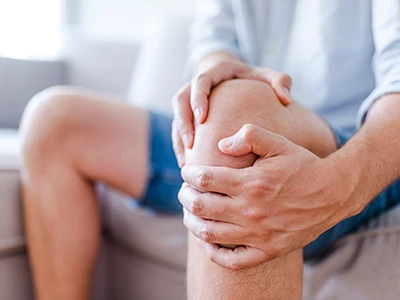
The knee is the largest and most complex joint in the body. It is incredibly powerful, routinely handling forces multiple times your body weight simply performing everyday activities. Standing still, your knees bear about 80 percent of your body weight. When running, the force can reach more than five times your body weight.
Imagine how deep squatting, lifting heavy weights, kneeling, jumping, sudden pivots can put pressure on the knees. That’s why sports like soccer, basketball and football are so high-risk for knee injury due to the twists and turns the knees perform at high speeds, with sudden changes in direction and impact.
The human knee is where three major bones come together – the femur, tibia and patella. It contains shock-absorbing cartilage like your meniscus, as well as stabilizing ligaments like your ACL. Tendons like quadriceps and hamstrings connect muscles to the bones. All of this connection is lubricated by synovial fluid within the joint capsule, enabling powerful performance and smooth movement.
Your knee functions like a well-oiled machine – until it doesn’t. A sprain or tear can instantly bring it all to a screeching halt.
The most common knee injuries include:
These injuries often result from the high-impact falls, twisting motions and sudden pivots seen in sports. Meniscus tears and ACL injuries are particularly frequent in athletes. While PCL and MCL sprains or injuries are also often seen, ACL injuries – which often present with a characteristic pop, intense pain, and immediate swelling – are by far the most common.
The knee’s meniscus is a C-shaped piece of fibrocartilage that functions as the knee’s main shock absorber, while ligaments (like the ACL, PCL, MCL, LCL) are fibrous tissues connecting the bones, providing joint stability. Imagine the meniscus as the supportive cushion, while ligaments are the strong bands holding the whole structure together.
Injuries to the meniscus vs. ligaments will present differently. Ligament tears often cause rapid swelling and meniscus tears often exhibit catching or locking of the knee.
Knee ligament sprains, as opposed to severe tears, involve stretching or microtears to the ligament fibers, leading to symptoms like pain, stiffness, swelling and bruising, often with limited range of motion. More severe tears or ruptures can lead to complete immobility. Sprains occur a spectrum; a tear is the most severe end of that spectrum (Grade 3), while Grade 1-2 sprains are less severe.
Whether we’re talking about a torn meniscus or an ACL sprain, these injuries can all cause immense pain, swelling and knee instability, often sidelining athletes, with surgery typically being the only option for treatment.
Until now.
Knee pain specialists – especially in the more advanced sports medicine clinics – are increasingly offering non-surgical knee treatments employing regenerative therapy for knees. Treatments like PRP or stem cell therapy are part of a wave of Regenerative Medicine options that have emerged on the scene and been true gamechangers for knee injuries like torn menisci and knee ligament sprains.
What is Regenerative Medicine? It is a field of medicine that focuses on restoring physical function by naturally repairing or replacing tissues, cells, or organs that have suffered injury or deterioration. It uses the body's own cells to promote healing and restore function, offering a promising new approach to sports injury treatment.
Why is Regenerative Medicine a powerful choice for healing your meniscus, ACL and other ligaments? In addition to enhanced tissue repair and improved performance, faster recovery is high on the list. Not to mention the reduced reliance on pain medication we’re seeing among athletes – all because of the innovative treatment approaches Regenerative Medicine brings.
Contact us online or call (240) 754-7954 to schedule a consultation with one of our specialists at the Center for Sports & Regenerative Orthopedics to see how you can potentially benefit from the game changing power of Regenerative Medicine for knee injuries.
Using stem cells injections for meniscus tears are a good example of a same-day procedure that can heal the injured tissue naturally. Unlike surgery, stem cell therapy does not require a painful or lengthy recovery period.
Adipose-derived stem cell (ADSC) therapy involves using stem cells taken from the patient’s own fat (adipose) tissue and injecting them into the injured knee. These ADSCs have a remarkable ability to reduce inflammation and promote the repair of tissues. ADSC treatments have emerged as a promising option to treat knee pain in conditions ranging from acute sports injuries to osteoarthritis.
While adipose-derived stem cell therapy uses stem cells derived from fat tissue, mesenchymal stem cells therapy uses adult stem cells found in blood. A study at Duke, published in Nature in November, 2023, found that mesenchymal stem cells (MSCs) offered the same level of benefit as injected corticosteroids to patients with knee osteoarthritis.
Some treatments use exosomes from stem cells to reduce inflammation, as well as enhance immune response and tissue repair.
Platelet-rich plasma (PRP) uses human blood to trigger healing. Probably the best known treatment to emerge in the field of Regenerative Medicine, PRP shots have been used extensively by major athletes to restore knee function.
Viscosupplementation - also known as gel shots or rooster comb injections – Involves injecting hyaluronic acid (HA) into a joint to improve lubrication and reduce pain.
The field of Regenerative Medicine for knee treatment is exploding with new treatment options, and the list keeps growing. Gene therapy uses RNA to target genes that affect tissue regeneration, while 3D bioprinting for knee injuries is making it possible to create custom implants for joint replacement - or scaffolds for tissue regeneration - using scans to match patient anatomy for precise fit, better function, and faster rehab.
Researchers are even developing silk-based bio-inks to print menisci and cartilage, using stem cells within 3D-printed structures to encourage the body to heal itself, potentially delaying or preventing total knee replacements for younger patients with cartilage damage.
Other therapies like Alpha-2-Macroglobulin (A2M) Therapy injects A2M, a naturally occurring protein that helps protect joints from degradation. It not only has the potential to promote joint healing, but even prevent arthritis.
Regenerative treatments for knee injuries – from PRP to various stem cell therapies – trigger the production of new, healthy tissue, bringing enhanced healing and restoring function and mobility naturally. This natural treatment approach actually taps into the body's innate natural healing abilities, promoting more natural, effective and faster repair, as compared to more traditional treatments that often only address symptoms.
In the past, even seemingly minor knee injuries could sideline an athlete’s career. Most athletes relied on conservative treatment methods like rest, ice, compression, and elevation (RICE), together with physical therapy and oftentimes pain medication. For severe sports injuries, they tried corticosteroids. Ultimately, surgery was the only option, but often, it didn’t work – and could even make things worse.
Sometimes knee injuries simply could not be successfully treated – and that’s the piece of this that is so important to understand. Regenerative Medicine is today being used to treat knee injuries that were otherwise difficult or impossible to treat in the past. When these innovative new therapies like PRP or stem cell therapy emerged, it opened possibilities never before considered for previously career-ending sports injuries.
With its minimally invasive treatment procedures, Regenerative Medicine offers natural healing with non-surgical knee treatment, which translates to less time on the sidelines. Speaking of time, what does a return-to-sport timeline look like for these types of knee injuries?
Let’s take our meniscus tear for an example again. Stem cell therapy offers quicker initial recovery – from days to weeks – to achieve a return to normal activity, with continued gradual healing over months. Meniscus surgery, on the other hand, has a much longer, more defined recovery period – from months to a year for a full return to sports.
For more questions about Regenerative Medicine’s ability to tackle major league injuries – as well as the everyday impact of aging, illness or weekend warrior injuries - speak with our experts today to see if Regenerative Medicine could be a gamechanger for you. Let our team at the Center for Sports & Regenerative Orthopedics help you achieve your goals and enhance your health and wellness goals with the healing potential of Regenerative Medicine.
Call (240) 754-7954 or contact us online to arrange a consultation with our Regenerative Medicine specialists at our offices in Alexandria, Virginia, or Waldorf, Maryland.
