
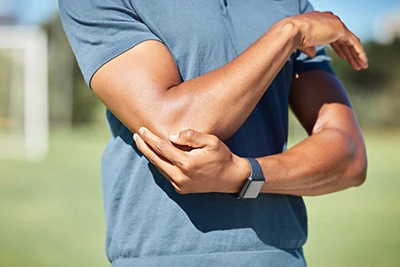
Tennis Elbow and Golfer’s Elbow are two common overuse injuries that usually result from repetitive arm motion experienced in various sports, work and leisure activities. You see it among individuals who spend a great deal of time doing anything from pitching to painting – or even fishing.
Both conditions stem from repetitive forearm motions, not just tennis or golf activities.
These elbow conditions are often seen in athletes – most often tennis players and golfers, as the names imply – but can also develop in athletes in any sport that involves repetitive gripping, throwing or swinging, like:
Musicians, especially those in string or percussion, can also develop either of the elbow conditions. In the music industry, they are often called "guitar elbow" or "piano elbow." Common in instruments like violin and cello as well as guitar and piano, these conditions arise from microtears and inflammation in the forearm tendons due to constant, strenuous use.
Tradespeople, like cooks, carpenters, painters, plumbers and more, can likewise develop either elbow condition due to similar overuse of the forearm tendons they experience in daily work.
The key difference between these two conditions is pain location (outside vs. inside) and the specific forearm muscles and tendons that are strained.
Both conditions are overuse injuries, but the specific forearm movements affected are on opposite sides of the arm. The main difference in symptoms is the location.
Tennis Elbow will cause tenderness and pain on the outer elbow, affecting the wrist-extension muscles. Symptoms range from pain when lifting or turning objects to pain when gripping or pain when reaching backward. Weakness in the hand and forearm is also common. Tennis Elbow symptoms almost always develop gradually. What may begin as mild pain or soreness on the outer elbow slowly worsens over weeks or months. The pain escalates to weakness, burning, along with difficulty gripping or turning doorknobs.
Golfer's elbow instead causes stiffness, pain and tenderness on the inner elbow, radiating down the forearm, affecting wrist-flexion muscles. It may worsen with shaking hands, gripping or wrist bending Golfer’s Elbow may present with numbness, tingling or weakness in the ring and/or pinky fingers. Pain often develops gradually and can affect the ability to open jars or lift items, as well as disturb sleep.
Tennis and Golfer's Elbow are diagnosed through a physical exam, focusing on pinpointing pain location - outer elbow for Tennis or inner elbow for Golfer’s. Seeing which specific movements worsen symptoms, like flexion for Golfer's Elbow or resisting wrist extension for Tennis Elbow. Diagnosis may be confirmed with ultrasound or MRI to rule out other issues, but a physical exam is generally sufficient.
Conservative methods may begin with rest, ice, anti-inflammatory drugs (NSAIDs), and bracing. If symptoms persist, progression to physical therapy may be next. Sometimes, steroid injections are used to restore function and reduce inflammation and pain before considering more extreme procedures like surgery.
Regenerative Medicine uses the body's own cells to promote healing and restore function, offering a promising new approach to treating injuries like Golfer’s or Tennis Elbow. This field of medicine focuses on restoring physical function by naturally repairing or replacing tissues, cells, or organs that have suffered injury or deterioration.
Many elbow pain specialists – especially in the more advanced sports medicine clinics – are increasingly offering non-surgical non-steroid and non-surgical treatments using regenerative therapy for elbow injuries like these.
Faster recovery, enhanced tissue repair and improved performance are all key factors involved in choosing Regenerative Medicine approaches. Innovative new therapies like PRP or stem cell therapy translated to reduced reliance on pain medication as well.
Contact us online or call (240) 754-7954 to schedule a consultation with one of our specialists at the Center for Sports & Regenerative Orthopedics to see how you can potentially benefit from the emerging power of Regenerative Medicine for elbow injuries like Tennis Elbow, Golfer’s Elbow, and more!
Regenerative medicine treatments for elbow injuries focus on harnessing the body's healing power. Using platelet-rich plasma (PRP) and stem cell therapy (from bone marrow or fat), often combined with platelet-rich fibrin (PRF), it can be remarkably effective in repairing tendons, ligaments, and cartilage, reducing pain and inflammation, as well as promoting tissue regeneration for conditions like Tennis and Golfer’s Elbow, as well as arthritis or bursitis affecting the elbow.
Minimally invasive, outpatient procedures like these involve concentrating healing factors from your blood or cells from bone marrow or fat and injecting them into the damaged elbow area to accelerate healing, triggering the production of new, healthy tissue. It can bring enhanced healing, restoring function and mobility naturally.
These treatment approaches tap into the body's innate natural healing abilities, promoting more natural, effective and faster repair, as compared to more traditional treatments that often only address symptoms.
For more questions about when Regenerative Medicine is an appropriate choice for elbow injuries, speak with our experts today to see if Regenerative Medicine could keep doing what you love. Let our team at the Center for Sports & Regenerative Orthopedics help you achieve your goals and enhance your health and wellness goals with the healing potential of Regenerative Medicine.
Call (240) 754-7954 or contact us online to arrange a consultation with our Regenerative Medicine specialists at our offices in Alexandria, Virginia, or Waldorf, Maryland.
