
Ulnar Collateral Ligament (UCL) is the elbow's primary stabilizer, making it extremely critical for overhead throwing. Any sport that requires high impact bracing, repetitive swinging or forceful arm rotation can expose the UCL to extreme torque, stretching and tearing – potentially leading to a complete or partial UCL sprain or tear. Regenerative Medicine options can be effective, including PRP or Prolotherapy, and help avoid Tommy John surgery.
Call (240) 754-7954 or contact us online to arrange a consultation with our Orthopedic and Sports Medicine specialists at our offices in Alexandria, Virginia, or Waldorf, Maryland.
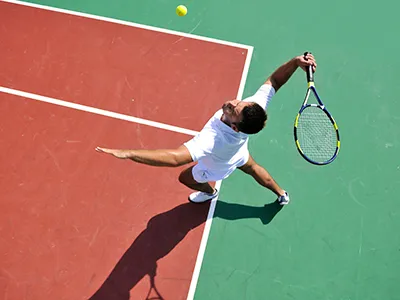
Overhead athletes like pitchers and quarterbacks, as well as those in sports like volleyball, golf and tennis, are more prone to develop UCL Sprains. A UCL sprain involves the overstretching or tearing of the ulnar collateral ligament (UCL).
The UCL connects the humerus (upper arm bone) to the ulna (forearm bone) and is located on the inner side of the elbow.
This ligament is the elbow's primary stabilizer, making it extremely critical for overhead throwing. But any sport that requires high impact bracing, repetitive swinging or forceful arm rotation can expose the UCL to extreme torque, stretching and tearing – leading to a complete or partial UCL sprain.
The first concern many overhead athletes express after being diagnosed with a UCL Sprain is worry that they will need Tommy John surgery. Fortunately, many low-grade/partial UCL sprains can heal without surgery using regenerative medicine plus a structured throwing progression.
Now, some high-demand throwers – especially those with complete tears – may still require surgery, but it is never a foregone conclusion that surgery is the only option. There are alternatives to Tommy John surgery that can be explored.
For partial UCL tear treatment, it’s important to be thoroughly evaluated by an expert and experienced Sports Medicine clinic that is experienced in non-surgical UCL treatment and Regenerative Medicine options. In Alexandria, VA or Waldorf, MD, the Center for Sports & Regenerative Orthopedics can provide a full-service evaluation, diagnosis and personalized treatment plan for any UCL injury.
An ulnar collateral ligament (UCL) sprain often first presents with sharp, localized pain on the inside of the elbow and a sudden drop in velocity and control when throwing or other overhead motions. Other signs and symptoms include:
Early evaluation after the condition develops can help to prevent further damage and, in some cases, even permanent disability from progressive joint instability, chronic pain and arthritis.
UCL Sprains or Tears are typically diagnosed from a clinical exam and patient history. If the patient complains of the above symptoms, injury to the UCL is almost always implicated. Orthopedic or sports medicine specialists often use MRI, ultrasound or X-rays to rule out other issues.
UCL sprains or tears can often be difficult to diagnose at the beginning. Symptoms can often overlap with other conditions that affect the upper extremities. Early misdiagnosis is common. The most common conditions a UCL sprain is mistaken for initially is Golfer's Elbow (Medial Epicondylitis) because it presents with sharp, localized pain in the same spot as UCL injuries. Other common misdiagnoses include:
To differentiate a UCL Sprain from these conditions or others, orthopedic specialists often rely on specific stress tests, including the moving valgus stress test. An MRI is also often necessary to visualize the soft tissue and confirm it is the UCL at issue and the extent of ligament damage.
In addition to throwing rest, non-surgical treatment for UCL tears or sprains may include:
Ultrasound-guided PRP for UCL tears or sprains is often the lead option for treatment. At the Center for Orthopedic & Sports Medicine,our providers have the training, experience and expertise in ultrasound examination for careful diagnosis and assessment along with ultrasound-guided injections. It is an essential differentiator when choosing a sports medicine specialist in UCL Sprain treatment for overhead athletes.
Non-surgical recovery for a partial UCL tear typically takes 12 to 16 weeks. This projected timeline follows a strict progression from complete rest to physical therapy then eventually what’s called an “interval throwing program” more commonly referred to as a “return-to-throw timeline.”
Developing a return to-throw timeline after UCL injury is critical to your recovery. While individual results will always vary, the following table with its phased interval throwing program is a good timetable to reference in developing your own plan.
Full clearance to return to competitive games depends on remaining completely asymptomatic during all throwing drills.
Many low-grade/partial UCL sprains can heal without surgery using regenerative medicine plus a structured throwing progression.
Throwing should be restricted until there is no pain and adequate rehabilitation and strength training have been completed. For a non-operative UCL injury, you should generally begin an interval throwing program (ITP) or return-to-throw regimen between 6 to 12 weeks after your initial injury. The exact timing depends entirely on your pain levels and clearance from your physician.
The exact timing and progression of your recovery depends on the severity of the UCL sprain or tear. Mild strains can heal in 4 to 6 weeks, while partial tears may require up to 2 to 3 months of strict rest.
The “Tommy John fear” is a common one, but There are alternatives to Tommy John surgery that can be explored. For partial UCL tear treatment, it’s important to be thoroughly evaluated by an expert and experienced Sports Medicine clinic that is experienced in non-surgical UCL treatment and Regenerative Medicine options.
While not every injury requires immediate medical attention, you should always seek medical care if your pain, stiffness or loss of range of motion continue to worsen. It is essential to rule out severe tears and prevent long-term pain or disability.
You actually should seek urgent care if your elbow function does not improve with rest, is unstable, cannot bear any weight, or shows significant deformity, bruising or swelling.
Untreated UCL injuries can progress to the point of permanent damage and complete disability.
Regenerative medicine options, ideally ultrasound-guided PRP treatment, can be ideal for partial tears – especially if you are a non-throwing athlete who simply wants to improve daily function. But Tommy John surgery is the gold standard for complete tears, especially in elite overhead throwers who need to maximize joint stability.
It is important to find an orthopedic sports medicine specialist who is not only experienced in dealing with conventional treatment methods for UCL injuries, but who is also knowledgeable about emerging Regenerative Medicine therapies.
New options in Regenerative Medicine are continually being developed. Our team stays on top of the latest developments. Contact us online or call (240) 754-7954 to schedule a consultation at our offices in Alexandria, Virginia, or Waldorf, Maryland, with one of our specialists.
At the Center for Sports & Regenerative Orthopedics we can answer all your question. See how you can potentially benefit from the emerging power of Regenerative Medicine and other options for UCL sprains or tears.
